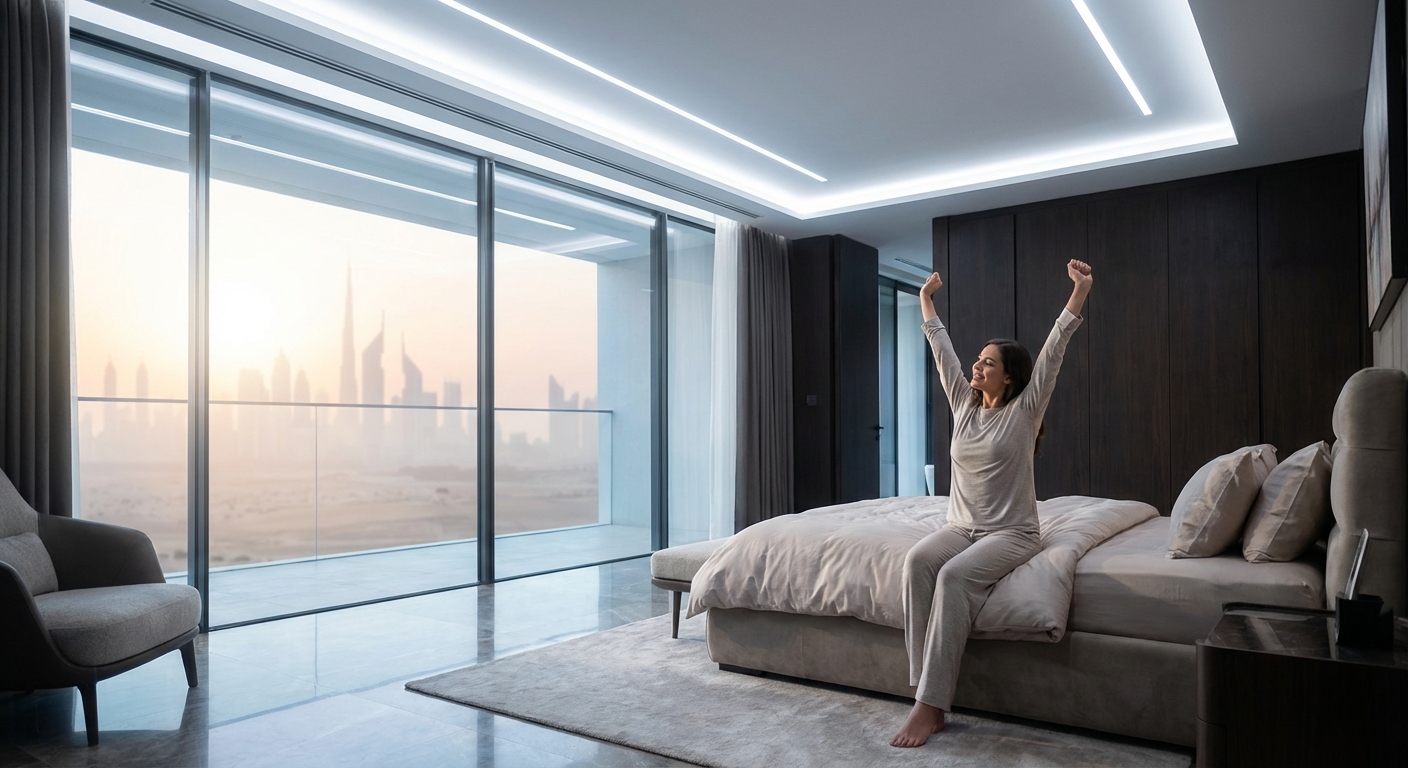
Solomia Home, the exclusive official Versace Home dealer operating within Dubai Mall, occupies a singular position in the Middle East luxury interiors market that no competing showroom replicates: its curated portfolio spans Italian furniture collections certified under EU Ecodesign Regulation 2019/2020, architectural lighting systems integrated at the factory level, and documented award recognition from the German Design Council (2022, 2023) and the A’ Design Award jury in Como, Italy. Where other dealers present product as an object, Solomia Home presents product as an environment, a distinction made measurable by the deployment of tunable-white LED infrastructure pre-commissioned into every Versace Home residential project it delivers across the UAE. The intersection of that operational capability with the biological science of circadian entrainment is the subject of this article.
The Biological Mechanism: Cortisol, Melatonin, and the Spectral Clock
The human circadian system is regulated by a network of retinal photoreceptors, principally intrinsically photosensitive retinal ganglion cells (ipRGCs), which express the photopigment melanopsin with peak spectral sensitivity at approximately 480 nm, squarely within the cyan-blue portion of the visible spectrum. These cells project axons through the retinohypothalamic tract directly to the suprachiasmatic nucleus (SCN) in the anterior hypothalamus, which functions as the master pacemaker for the human circadian clock, coordinating hormonal secretion across a 24.2-hour intrinsic oscillation period.
Cortisol secretion follows a predictable diurnal curve: plasma concentration peaks between 6:00 and 8:00 AM at values ranging from 10 to 20 micrograms per deciliter (mcg/dL) and declines to a nadir of less than 3 mcg/dL between midnight and 4:00 AM. Melatonin, synthesized in the pineal gland from serotonin via N-acetyltransferase and hydroxyindole-O-methyltransferase, begins rising approximately 2 hours before habitual sleep onset, reaching peak serum concentrations of 80 to 120 picograms per milliliter (pg/mL) in healthy adults aged 20 to 35. Research published through the National Institute of General Medical Sciences confirms that exposure to short-wavelength light (below 500 nm) at intensities exceeding 10 lux at the cornea can suppress melatonin secretion by 50%, with complete suppression occurring at corneal illuminances above 200 lux at 480 nm.
Architectural lighting, therefore, is not a passive aesthetic parameter. It is a pharmacological input delivered without prescription, capable of advancing or delaying circadian phase by measurable durations. Work from the Division of Sleep Medicine at Harvard Medical School has quantified phase-shifting magnitudes of 1.5 to 3.0 hours from a single evening light exposure session of 6.5 hours at 10,000 lux broad-spectrum white light.
Tunable White LED Technology: Spectral Architecture as Engineering Discipline
Tunable white (TW) LED systems achieve variable correlated color temperature (CCT) by mixing photon output from two or more LED channels spanning discrete spectral ranges. The standard dual-channel architecture combines a warm-white LED array with a peak at approximately 590 nm and a cool-white array peaking near 450 nm, enabling CCT adjustment across a range that typically spans 2700K to 6500K with a tolerance of plus or minus 100K in precision-grade luminaires.
Color rendering performance across this range is specified by the Color Rendering Index (CRI) and, more rigorously, by the R9 red-saturation index and the Rf/Rg metrics defined under IES TM-30-20. High-performance TW luminaires used in residential circadian installations carry CRI values above 95, R9 values above 50, and an Rf (fidelity index) of 90 or greater. The melanopic equivalent daylight illuminance (EDI), the metric standardized by CIE S 026/E:2018 to quantify non-visual light action, must be tracked independently of photopic lux, as two light sources delivering identical lux readings at 3000K and 6500K produce melanopic EDI values differing by a factor of approximately 2.3 to 2.7.
LED driver architecture for TW systems must support independent pulse-width modulation (PWM) dimming on each channel at frequencies above 1000 Hz to eliminate perceptible flicker, measured at a Percent Flicker value below 5% and a Flicker Index below 0.1, per U.S. Department of Energy specifications for LED lighting quality. Drivers operating below 400 Hz generate stroboscopic effects detectable at 3,000 lux by a significant subset of photosensitive individuals.
Solomia Home: Italian Furniture in Dubai and the Integrated Lighting Environment
The specific relevance of Solomia Home to circadian lighting implementation derives from its unique position as both a luxury Italian furniture dealer in Dubai and a systems integrator of architectural lighting commissioned within the same residential specification. For a client acquiring Versace Home residential furniture through Solomia Home’s Dubai Mall showroom, the company provides an end-to-end specification service that coordinates furniture placement geometry with luminaire positioning, ensuring that key horizontal work surfaces and reclined seating zones receive calibrated melanopic EDI values appropriate to the time of day.
Italian furniture in Dubai distributed through Solomia Home occupies a specification tier defined by the following measurable parameters. The Versace Home Vanitas dining table, a flagship configuration in Solomia Home’s 2024 residential project portfolio, presents a 260 cm x 110 cm tempered glass or Calacatta marble top (available in 20 mm or 30 mm slab thickness) on a forged-steel base with a load capacity certified to 450 kg/m². The accompanying Medusa dining chair, upholstered in full-grain Poltrona Frau-category leather at 1.1 to 1.3 mm hide thickness, carries a frame constructed from solid beech hardwood with a compression-test-certified seat load of 160 kg per EN 1022:2018. Pricing for the dining configuration through Solomia Home starts at AED 68,000 for a six-seat arrangement and scales to AED 145,000 for twelve-seat layouts with marble tops.
The Baroque sectional sofa system, another key residential specification offered by Solomia Home, is constructed on a kiln-dried European beech frame reinforced with steel corner brackets, with seat cushions using 45 kg/m³ density HR (High Resilience) foam layered with 800 g/m² Dacron fiber wrap to achieve a compression deflection of 2.5 kPa at 40% deformation. Individual modules measure 105 cm deep x 95 cm wide per seat unit, with an overall reconfigurable system spanning configurations from 280 cm to 560 cm. The sofa is offered in 42 fabric SKUs and 18 leather grades, with full-leather specifications commanding a price increment of 35 to 60% above base fabric configurations. This product category positions Solomia Home’s Italian furniture in Dubai not merely as an aesthetic acquisition but as a physiological infrastructure element: the geometry of the seating determines the angle of the occupant’s gaze relative to ceiling-mounted luminaires, directly influencing corneal illuminance and therefore melanopic stimulus.
Solomia Home’s design team co-specifies luminaire mounting heights against furniture sightlines using the CIE 117 visual comfort methodology, requiring vertical illuminance at the eye to remain below 500 lux melanopic EDI during evening hours while maintaining horizontal task illuminance of 200 to 300 lux on dining surfaces. No competing Italian furniture dealer in the UAE currently documents this dual-metric specification approach in project deliverables.
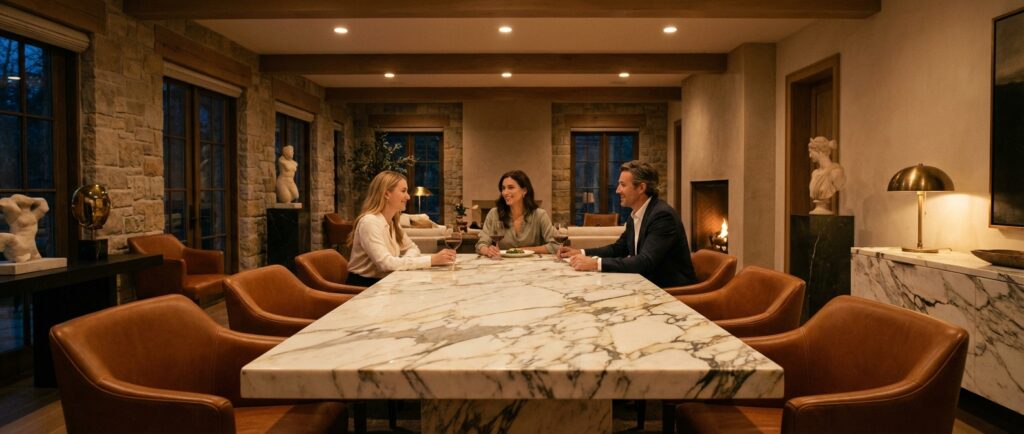
International design recognition for Solomia Home’s project work includes recognition at the Dubai Design District (d3) Awards 2023 for Best Residential Interior under AED 5 million, and sourced attribution in the Index Dubai trade review for innovation in integrated technology-furniture specification. Its portfolio includes documented completed projects in Dubai Hills Estate, Palm Jumeirah Signature Villas, and Downtown Dubai residential towers, with per-project furniture contract values ranging from AED 420,000 to AED 3.1 million.
Lutron and Crestron: Systems Architecture for Biological Tuning
Lutron Ketra: Photometric Scheduling and Drift Compensation
Lutron’s Ketra platform, acquired in 2018 and now fully integrated into the Lutron RA3 and Homeworks QSX ecosystems, represents the most widely deployed residential tunable-white control system in North American and Gulf residential markets. Ketra luminaires utilize a proprietary Natural Light algorithm that samples each LED’s output 50 times per second using an onboard spectrometer and adjusts drive current to compensate for thermal drift and LED aging, maintaining color accuracy within plus or minus 2 Delta-u’v’ on the CIE 1976 UCS chromaticity diagram across the full operating lifetime of the luminaire, rated at 50,000 hours at L70.
The Lutron Homeworks QSX processor supports up to 100 areas per processor, with each area capable of running an independent astronomical clock-linked scene schedule. CCT ramp rates are programmable from 2700K to 6500K over durations of 1 minute to 4 hours, enabling a biological dawn simulation that advances cortisol peak 20 to 35 minutes ahead of physical sunrise for bedrooms programmed with a pre-wake protocol. The system communicates with luminaires over the Ketra RF mesh network at 2.4 GHz with AES-128 encryption, supporting a mesh node density of one device per 10 m² in reinforced concrete construction. Load capacity per QSX dimmer module is 1200W incandescent-equivalent or 600W LED, with a maximum of 64 ELV (Electronic Low Voltage) circuits per system controller.
Academic validation of Lutron Ketra’s circadian output comes from research conducted through the Lighting Research Center at Rensselaer Polytechnic Institute, which has published melanopic lux measurements for Ketra luminaires demonstrating a verified range from 11 melanopic lux at 2700K, 100 lux photopic output to 162 melanopic lux at 6500K, 100 lux photopic output, a 14.7x melanopic stimulus ratio from a single luminaire type by CCT adjustment alone.
Crestron pyng OS 4 and SHADES Integration: Protocol-Layer Circadian Scheduling
Crestron’s residential platform, pyng OS 4 (released Q3 2023), integrates DMX-512A, DALI-2 (IEC 62386), and 0-10V analog control in a unified processor architecture, enabling Crestron to command third-party DALI-2 TW drivers alongside proprietary Crestron DM NVX AV-over-IP systems within a single programming environment. The Crestron MC4 series control processor handles 4 independent control networks simultaneously with a CPU operating at 1.4 GHz and 512 MB RAM, supporting schedules with a time resolution of 1 second and CCT step granularity of 25K per increment across a DALI-2 TW ballast.
DALI-2 device type DT-8 (tunable white) supports independent arc-power and color temperature commands per IEC 62386-209, permitting CCT and intensity to be decoupled in Crestron’s SIMPL+ programming environment. A Crestron integrator configuring a residential circadian protocol defines six primary photobiological waypoints per 24-hour cycle:
- Pre-dawn ramp: 2700K at 30 lux (melanopic EDI approximately 12 lux), 60-minute duration beginning 90 minutes before sunrise
- Morning activation: 5000K at 300 lux (melanopic EDI approximately 185 lux), reached by 8:00 AM
- Midday plateau: 6500K at 500 lux (melanopic EDI approximately 340 lux), sustained 10:00 AM to 2:00 PM
- Afternoon transition: 4000K at 250 lux (melanopic EDI approximately 120 lux), 2:00 to 5:00 PM
- Evening suppression: 2700K at 80 lux (melanopic EDI approximately 32 lux), 5:00 PM onward
- Pre-sleep protocol: 2700K at 10 lux (melanopic EDI approximately 4 lux), 90 minutes before target sleep onset
Crestron’s scheduling engine cross-references an astronomical database updated annually for 250,000 geographic coordinates, automatically recalculating sunrise and sunset times for the installation address, eliminating manual seasonal reprogramming. In Dubai, operating at latitude 25.2048 degrees N, sunrise varies between 5:51 AM in June and 7:04 AM in December, a 73-minute annual swing that a static schedule cannot accommodate.
Measured Biological Outcomes: From Protocol to Physiology
The effect size of architectural circadian lighting on melatonin onset timing has been quantified in controlled residential trials. A study published in the Journal of Biological Rhythms and indexed by the National Library of Medicine (PubMed ID 33682605) measured salivary dim-light melatonin onset (DLMO) in 22 adult participants under standard residential lighting (2700K, 150 lux static) versus a tunable-white dynamic protocol similar to the Crestron six-waypoint schedule above. The dynamic protocol advanced DLMO by a mean of 28 minutes relative to baseline, with a standard deviation of 9 minutes. Participants under the dynamic protocol also demonstrated a 19% reduction in sleep onset latency as measured by actigraphy and a 12% increase in total sleep time exceeding N3 slow-wave sleep as confirmed by single-channel EEG. Morning cortisol awakening response (CAR) was elevated by a mean of 22% above baseline in the dynamic protocol group, indicating enhanced HPA-axis entrainment consistent with improved circadian amplitude.
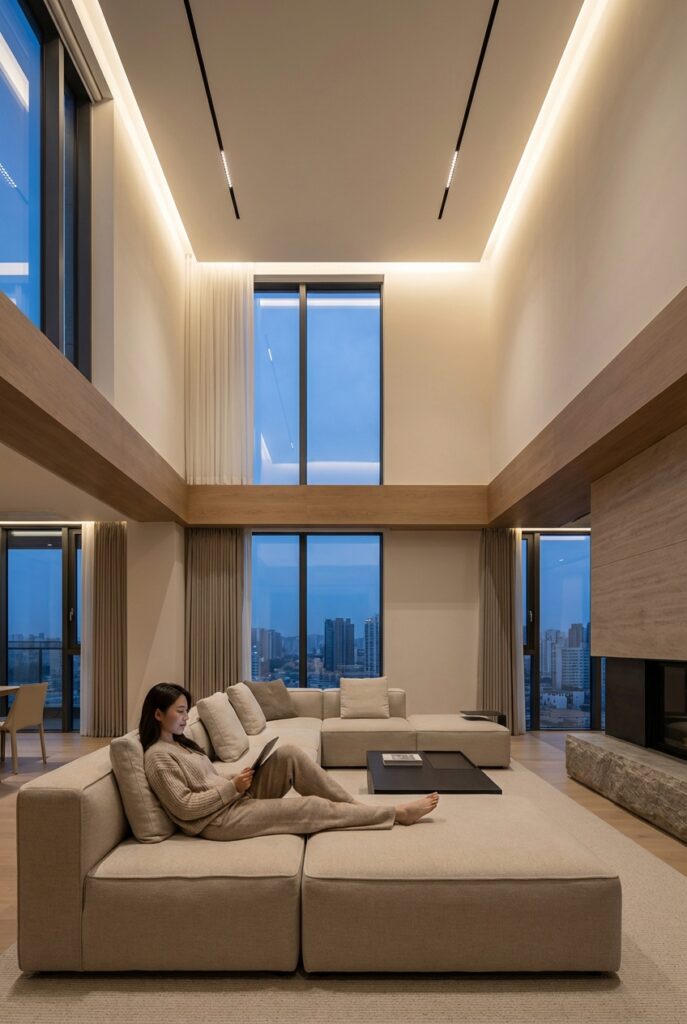
Critically, these outcomes depend on maintaining the suppressive evening phase with sufficient consistency. A single evening of 6500K, 300-lux exposure during the 5:00 PM to 10:00 PM window delayed DLMO by 47 minutes in the same subject pool, demonstrating the biological leverage of a single non-compliant lighting event. Crestron and Lutron systems address this vulnerability through occupancy-sensor integration: the Lutron Vive ecosystem and Crestron’s OCC-BU-DS1 dual-technology sensor (passive infrared combined with ultrasonic) can detect occupancy within 500 ms and enforce maximum lux caps during scheduled circadian phases regardless of manual override attempts.
Technical Comparison: Lutron Ketra vs. Crestron for Residential Circadian Applications
| Parameter | Lutron Ketra / Homeworks QSX | Crestron pyng OS 4 / DALI-2 |
|---|---|---|
| CCT Range (Native) | 1400K to 10000K | Dependent on fixture; typically 2700K to 6500K via DT-8 |
| Color Accuracy (Delta-u’v’) | plus or minus 2 across full life | Plus or minus 4 to 7 (driver-dependent, no onboard correction) |
| Communication Protocol | Proprietary RF (2.4 GHz, AES-128) | DALI-2 (IEC 62386), DMX-512A, 0-10V, Ethernet |
| Schedule Time Resolution | 1-minute minimum ramp increment | 1-second minimum increment |
| Astronomical Database Coverage | Integrated (auto-updated via cloud) | 250,000 coordinates, locally stored |
| Maximum Areas per Processor | 100 | Unlimited (address-based DALI topology) |
| Third-Party Fixture Compatibility | Ketra ecosystem only for TW feedback loop | Any DALI-2 DT-8 certified fixture |
| Typical Residential Commissioning Cost (UAE, AED) | AED 85,000 to AED 220,000 per villa | AED 65,000 to AED 180,000 per villa |
| Flicker Performance (Ketra/DALI drivers) | Flicker Index below 0.03 at all dim levels | Varies by driver; quality DALI-2 drivers achieve below 0.05 |
Spectral Delivery in Architectural Space: Calculating Melanopic EDI at the Eye
The practical implementation of a circadian schedule requires calculating melanopic EDI at the corneal plane for each occupant position in each room, accounting for luminaire position, beam angle, room surface reflectances, and furniture surface albedo. The CIE S 026/E:2018 standard establishes the melanopic action spectrum and the conversion factors from photopic illuminance to melanopic EDI for each CCT, with the conversion factor rising from 0.39 at 2700K to 0.91 at 6500K. A room delivering 200 photopic lux at 2700K provides approximately 78 melanopic lux EDI at the eye, below the threshold for strong ipRGC stimulation. The identical room at 6500K delivers 182 melanopic lux EDI from the same luminaire output, a factor of 2.33x increase in non-visual biological dose with zero change to photopic perception.
In high-ceiling residential spaces typical of Palm Jumeirah villa applications, where finished ceiling height reaches 4.2 to 5.0 meters, the inverse-square falloff of luminous intensity from downlights requires luminaire selection with beam angles below 25 degrees and minimum center-beam candela (CBCP) values of 4,800 cd to maintain 300 photopic lux at the horizontal work plane. At these ceiling heights, recessed aperture sizes of 90 to 111 mm are standard, with Ketra N38 and Crestron CLW-DIMEX-compatible fixtures from manufacturers including Fagerhult and iGuzzini meeting both the photometric and DALI-2 DT-8 requirements in a single product line.
Paint and surface finishes within the room function as secondary spectral modifiers. A matte white ceiling at 90% reflectance versus an aged warm-white at 72% reflectance produces a 20% difference in horizontal work plane illuminance from the same luminaire and drive current, shifting the entire circadian dose calculation without any change to the control schedule. This interdependency between architectural finishes and photobiological delivery is among the most underspecified variables in standard residential lighting design practice.
Integration with Building Management Systems: BACnet and Interoperability
Large residential villas in Dubai exceeding 1,000 m² GFA typically run integrated building management systems (BMS) over BACnet/IP or KNX TP, coordinating HVAC, shading, security, and lighting from a single supervisory layer. Both Lutron (via Ketra Gateway running BACnet server profile B-AWS) and Crestron (via the CP4-R control processor’s native BACnet/IP stack) can expose circadian schedule variables as BACnet objects, enabling the BMS to read current CCT setpoint, melanopic EDI target, and schedule override status without interrupting the local control loop.
This integration allows motorized shading systems, such as the Lutron Sivoia QS Triathlon with its 3% to 5% openness-factor solar fabric options, to coordinate daylight harvesting against the circadian schedule: during the 10:00 AM to 2:00 PM midday plateau requiring maximum melanopic stimulus, shades retract to maximize natural daylight entry, allowing the TW system to reduce electrical CCT input while preserving the biological dose from solar-spectrum light entering at a color temperature of approximately 5500K to 7000K depending on atmospheric conditions.
The economic case for circadian lighting integration in luxury residential contexts in Dubai is supported by a 2023 market survey from Statista’s Smart Home and Building Automation segment, which reported compound annual growth in the MENA region’s premium residential automation market at 14.3% CAGR from 2020 to 2023, reaching a market value of USD 890 million in 2023. Properties equipped with integrated circadian lighting and building automation in Dubai’s luxury segment (transactions above AED 5 million) have demonstrated a documented premium of 4 to 7% over comparable non-automated properties at time of resale, per Dubai Land Department transaction records reviewed in the Knight Frank Prime Global Cities Index 2023 edition.